Posts

Revision of Grammmar rules | Grade 9

 There is/are  &  There was/were Rules:  1. "There is" is used with singular nouns (e.g: bread, Sun, James). "There are" is use with plural nouns (e.g: pans, dancers, Stars). 2. "There was" (singular form) & "There were" (plural form), are used as the past tense forms of "is" and "are". When a sentence starts with or includes the word " There ", the auxhilary verb that follows it (i.e: is, are, was, were ) must agree with the main noun in the sentence. See two examples below -  A) There was no bread left in the house. B) There are two packs of biscuits in the cupboard "House" and "Cupboard" are nouns too, but they are not the main nouns; the verbs in each sentence does not connect to those nouns since they are too far away from it. Here are some more examples: There is a cake in the oven. There are many mangoes on the tree. There was one customer in the store. Practice: Se...

English SBA Part one | Week 6 | Grade 11

Image
 Your journey into the completion of the School Based Assessment begins with the Cover Page. This cover page must clearly state who you are, what school you attend, your country, your Subject - among other things. Take a look at this sample Cover Page, "XXXX" represents information that will be filled in at a later date.  Some important information: Do not use any "Fancy" fonts, nothing like Cursive or Old English. Follow the correct grammar as outlined in the sample above - "School Based", not "School Base". Select a picture that properly represents your topic*, it must be clear and not too large. Groups per Topic Group #1 - Animal Abuse Gadjadar Cedric Babulal Tanuja Biachoo Sandya Narine Sarah Group #2 - Rape Guidharry Joshua Cain Emisha Chattergoon Anjanie Dexter Krishani Group #3 - Capital Punishment (The Death Sentence) Khan Moein Farouk Fareeza Fraser Latipha Fraser Tia Group #4 - Sexual Harassment Pile Alwin Gaffoor Ameena George Shania G...

Report Writing | Garde 9 | Week 5

Image
With Descriptive English forming an important part for exams like CSEC and CAPE, we bring to you in this post, the Report Writing Format and a Sample Report. So, how to write a report?  Unlike an essay, which sets out to defend a writer's view about a topic and does not have to feature headings, a report discusses a topic in a structured, easy-to-follow format. Reports are divided into sections with headings and subheadings. Reports can be academic, technical, or business-oriented, and feature recommendations for specific actions. Reports are written to present facts about a situation, project, or process and will define and analyze the issue at hand. Ultimately, the goal of a report is to relay observations to a specific audience in a clear and concise style. Let's review the proper report writing format so you can craft a professional finished product. Preparation and Planning First, you should take some time to prepare and plan for your report. Before you start writing, iden...

Formal and Informal letters | Grade 9 | Week 4

Image
Before the wide-spread use of modern technology that made communication so easy, the art of writing a letter was considered an important requirement. Even today a letter is an important means of communication in both the workspace as well as our personal lives.  A letter is a written message that can be handwritten or printed on paper. It is usually sent to the recipient via mail or post in an envelope, although, this is not a requirement.  Now that E-mails and texts and other such forms have become the norm for communication, the art of letter writing has taken a backseat. However, even today a lot of our communication, especially the formal kind, is done via letters. Whether it is a cover letter for a job, or the bank sending you a reminder or a college acceptance letter, letters are still an important mode of communication. Which is why it is important that we know the intricacies of letter writing.

Types of Sentences | Grade 11 | Week 2

In the great big world of sentence types there are two main categories. One category deals with the Structure, i.e., the ways in which words are arranged and how punctuation is used to break it all up. Simple Compound Complex Compound-Complex These are all the types in this category. The other category deals with the Usage/Function of that sentence, i.e., how the sentences are meant to be read; as a:  question,  command,  declaration,  exclamation,  imperative (instructional),  or conditional. Those are all the types in that category.

Notices | Grade 10 | Week 1

Image
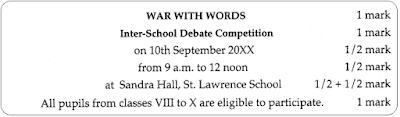
Notices are a part of daily life, I'm sure you can find more than one as you go about your daily life. The notice might seem like a topic for Business stream, but knowing how to create any of the different types of notices comes in very handy for anyone who does any kind of business. One important aspect of communication is business communication, also known as formal communication. Formal letters, memos, circulars, etc., are all forms of business communication. Another important tool of the same is a notice. Let's learn the meaning of notices and details of notice-writing. What exactly is a Public Notice? Notices, in general, are a means of formal communication targeted at a particular person or a group of persons. It is like a news item informing such person or persons of some important event. This can be an invitation to a meeting, an announcement of any event, to issue certain instructions, make appeals etc.  Public Notice to a School Body Public notices, like the example a...

Types of Poems | Grade 8 & 9 | Week 1

Image
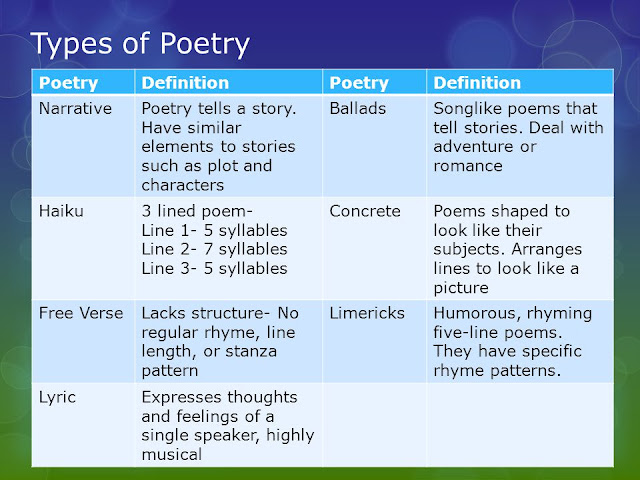
So you've made it to a higher level, congratulations. By now you will have done enough poetry to realize that that there are types of poems. Can you remember any of those types? Here's a handy reminder: There is one more type that is missing from here and that's the "Sonnet" type poems. English poets borrowed the sonnet form from the Italian poet Francesco Petrarch . Traditionally, it has fourteen lines of iambic pentameter linked by an intricate rhyme scheme . Iambic pentameter refers to its rhythm ; basically, each line of the poem has ten syllables , and every other syllable is stressed. The words I've put in bold in the paragraph above are important terms to understand in the field of poetry, and we will be covering them later in this lesson. Writing poetry is quite easy,  I can make one that's very... cheesy Rhyming words is little stress Count your syllables to be the best See? You can do that! In the picture above, they mention "Ballads...

Transitive & Intransitive verbs | Grade 9 | Week 2

Image
So, verbs, remember how there are different types of them?  Can you name any of the types? Think about that... then take a look down below. Now that your memory is refreshed, let's go into the topic for today - Transitive & Intransitive verbs. What are transitive and intransitive verbs? If you took the time to read the information in the picture above, you'll have read something about transitive verbs needing an object in the sentence to "transfer" it's action to; whereas an intransitive verb does not need an object, it does not have to link the "action" that it does to the subject/object of the sentence. Confused? Let's look at some examples, beginning with the TRANSITIVE VERBS 1. The speaker examined the iPhone 13 in the video. This the verb in this sentence (examined) is Transitive, see how it links to the object of the sentence? The object or objects in a sentence with a transitive verb (usually) directly follows the verb. A transitive ve...

Phrases and Clauses | Grade 8 | Week 1

Image
Clauses and Phrases ; sounds like they can be easily mixed up, right? They both are parts of a sentence, and phrases can be found within clauses.  Confusing? Let me put it this way, it's all about making sense . Sentences as a whole, must make sense grammatically ; that means the order and type of words, as well as the punctuation used, must obey the rules of English grammar. Within a sentence there are clauses and these come in two categories : Dependent and Independent . Basically, Independent clauses make sense on their own, when separated from their original sentence. Dependent clauses cannot stand by themselves, when you read them they sound wrong... like they're missing something. As for phrases, they too have different types . When a phrase is separated from it's original sentence we can identify what type it is based on what kind of word they begin with (think Noun, Verb, Preposition, etc.). However, when a phrase is identified within a sentence, it's type can...

Active & Passive verb Voice | Week 3 | Grade 8

Image
Active vs. Passive Voice GRAMMAR Active voice means that a sentence has a subject that acts upon its verb . Passive voice means that a subject is a r ecipient of a verb’s action.  Some writers may say that the passive voice is weak and incorrect, but it isn’t that simple. When used correctly and in moderation, the passive voice is fine. In English grammar, verbs have five properties: voice, mood, tense, person, and number; here, we are concerned with voice . The two grammatical voices are active and passive.

Letter to the Editor | Week 3, Lesson 1 | Grade 9

Image
Letter to The Editor But first, let me tell you a story. Last week friday, I was in New Amsterdam to buy some textbooks. After I bought what I needed and, walking back down N/A stelling road to the bus park, I decided to go visit an old friend of mine. Her snackette was located close to the stelling itself.  When I used to go to High School, my friends and I would be at her snackette every afternoon, rain or shine. The food was great, the place was well kept and always busy. Aunty Jenny and her husband ran that snackette and bar and they are very nice people.  This was during the time the Pontoon was operating, this big, long ferry that would be packed every morning and afternoon with school children from Multi, BHS, and NATI. This pontoon and the presence of so many school-going customers kept all the businesses alive and prosperous down that stelling road. Flash forward to 2020, the boats have stopped carrying passengers between Rosignol and New Amsterdam, stelling road gets...

Health and Family Life Education - Introduction | Grade 7

Image
This is likely the first time that you have taken a class on H.F.L.E, and you might be wondering what it's all about. H.F.L.E stands for Health and Family Life Education, and it is my goal as an H.F.L.E teacher to help you master life skills - skills that you will need now, and skills that you will need when you become an adult. These "Skills" that I am talking about aren't what you usually think of when you hear that word, instead I will teach you how to:  go about dealing with and solving the problems in your life.  think critically and filter out wrong information. manage your feelings (stress, depression, attraction, jealousy) understand yourself as an individual and care for your body. negotiate and communicate with people. care for the environment and use resources responsibly. The World Health Organisation (WHO) defines life skills as: "abilities which help us to adapt and behave positively so that we can deal effectively with the challenges of everyday li...

Assonance & Alliteration | Week 5, Lesson 3 | Grade 9

Image
  Assonance and Alliteration are two features of language that writers, especially poets, use.  They are meant to engage a reader’s auditory (i.e, listening) skills while also making the writing they are used in sound musical and fun to read. Assonance and Alliteration are mainly different in terms of what letter type is repeated and where.  Since poetry and prose use them heavily, they can be a little hard to distinguish to most people. What is Alliteration? Alliteration is a literary style that deals with the repetition of similar or identical consonant sounds. (All letters of the Alphabet, other than Vowels, are consonants) It makes a line fun to read and usually repeats the consonant sounds in a word, usually in the beginning those words, but may occur at any point. You may be familiar with this famous example of Alliteration from the old tongue-twister "Peter the piper".   E.g #1 - " P eter p iper p icked a p epper; p ut it in a p epper p ot", is the Guyanese ...

Clichés - Week 2, Lesson 3 | Grade 10

Image
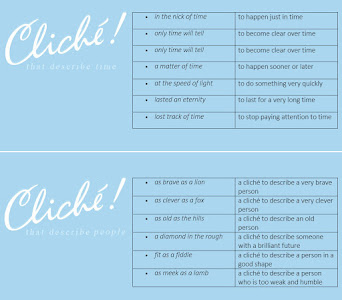
  What is a Cliché? A cliché is a word or phrase that has been overused in writing. Clichés such as “leave no stone unturned” have been used so much in writing that they have lost all their effectiveness. These phrases have become weak and meaningless. They usually contribute nothing to the message you are trying to convey and will be viewed, by the reader, simply as padding. A text full of clichés makes the writer appear lazy and uncreative and will, for many readers, kill the significance of the writing. As a young person reading through textbooks or stories, you'll come across certain old, almost meaningless phrases, that are used in an effort to express the writer's ideas. "Time heals all wounds." - This is a true statement, but it's been used so many times in books, movies, articles, etc - that it becomes boring and tired.  "Don't put all of your eggs in one basket." - You have probably heard this one before from your mother or grandmother. I...

Using a Colon | Grade 9 - Week 3, Lesson 3

  The colon   ( : )   and semicolon   ( ; ) are frequently used incorrectly in place of each other. The two punctuation marks serve very different purposes, and should not be used interchangeably. COLON A colon is used to give emphasis, present dialogue, introduce lists or text, and clarify composition titles. Emphasis — Capitalise  the first word after the colon only if it is a proper noun or the start of a complete sentence. (She had one love: Guyana, land of many waters.) Dialogue —Write the speaker's name, followed by a colon and his or her statement. (Reporter: What is the Golden Arrow of Achievement ? Dunn: It is a General Award and Guyana's fourth-highest award, to ‘any citizen of Guyana who has performed an outstanding and specific act of service or achievement of an exceptional nature'. ) Introduce lists, text or tabular material — Capitalise  the first word after the colon only if it is a proper noun or the start of a complete ...

Implicit Meaning - Week 1 Lesson 2 | Grade 9

Image
 An Idea like "Implicit meaning" can be hard to understand sometimes. Like any big or confusing word, there are other smaller easier words we can break it down into.  It's like talking about something without mentioning the name of that thing. Check out these examples:  1. Of the 24 hours in a day, there is none I love more than those hours when the sky becomes painted with oranges and pinks - when the air becomes cooler and the crickets start to sing. What time of day do I love the most? If you guessed "Sunset" or "twilight", you're correct. I did not tell you just like that, that I love the sunset - I told you about the colours in the sky and the coolness of the air and the crickets that start making their sounds. With this information you can then understand what time of day I am talking about. 2. As he bit into some crunchy jam and toast as he read the newspaper spread in front of him. Over on the stove, the tea he forgot to pour out was get...

Descriptive Writing - Different attitudes | Grade 9

Image
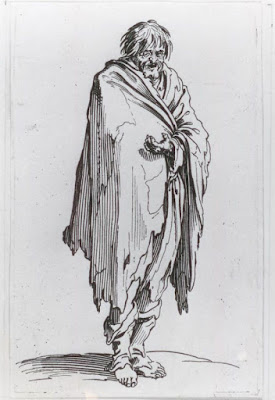
In the last Grade 9 English "A" post, you were asked to write a 2 paragraph descriptive story based on a picture you took or drawing you made. In today's post you can learn to describe a person from different angles of approach.  For example, we can describe a beggar in any of these ways: Illustration of a beggar in 'rags' As seen by an anonymous writer, e.g. The beggar shuffled into the shop almost apologetically, holding out half a coconut shell with sad persistence...  As a first person description, e.g.  I watched the beggar thoughtfully and wondered whether he earned more than I did from his earnest entreaties to elderly tourists...  As seen Through The Eyes of a child (by the Narrator), e.g. The scene always puzzled Mitzie, being young as she was. She watched her father take off the clean clothes he wore at home, and put on some old and dirty rags. “It’s his work”, her mother explained nervously. “He works in a very dirty place, and he doesn't want to sp...