Active vs. Passive Voice GRAMMAR Active voice means that a sentence has a subject that acts upon its verb . Passive voice means that a subject is a r ecipient of a verb’s action. Some writers may say that the passive voice is weak and incorrect, but it isn’t that simple. When used correctly and in moderation, the passive voice is fine. In English grammar, verbs have five properties: voice, mood, tense, person, and number; here, we are concerned with voice . The two grammatical voices are active and passive.
Before the wide-spread use of modern technology that made communication so easy, the art of writing a letter was considered an important requirement. Even today a letter is an important means of communication in both the workspace as well as our personal lives. A letter is a written message that can be handwritten or printed on paper. It is usually sent to the recipient via mail or post in an envelope, although, this is not a requirement. Now that E-mails and texts and other such forms have become the norm for communication, the art of letter writing has taken a backseat. However, even today a lot of our communication, especially the formal kind, is done via letters. Whether it is a cover letter for a job, or the bank sending you a reminder or a college acceptance letter, letters are still an important mode of communication. Which is why it is important that we know the intricacies of letter writing.
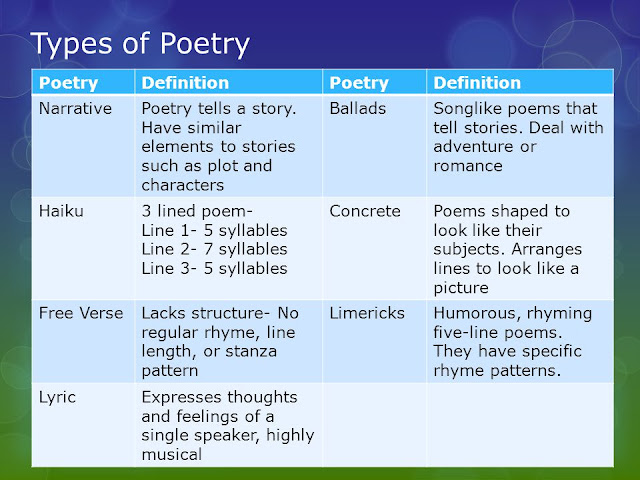
So you've made it to a higher level, congratulations. By now you will have done enough poetry to realize that that there are types of poems. Can you remember any of those types? Here's a handy reminder: There is one more type that is missing from here and that's the "Sonnet" type poems. English poets borrowed the sonnet form from the Italian poet Francesco Petrarch . Traditionally, it has fourteen lines of iambic pentameter linked by an intricate rhyme scheme . Iambic pentameter refers to its rhythm ; basically, each line of the poem has ten syllables , and every other syllable is stressed. The words I've put in bold in the paragraph above are important terms to understand in the field of poetry, and we will be covering them later in this lesson. Writing poetry is quite easy, I can make one that's very... cheesy Rhyming words is little stress Count your syllables to be the best See? You can do that! In the picture above, they mention "Ballads...


Comments